Every BI tool has one and almost none of them talk about it, because a compiler is not a demo. But it is where the security properties actually live, and if you are evaluating a platform it is the component whose design you should ask about first.
What goes in
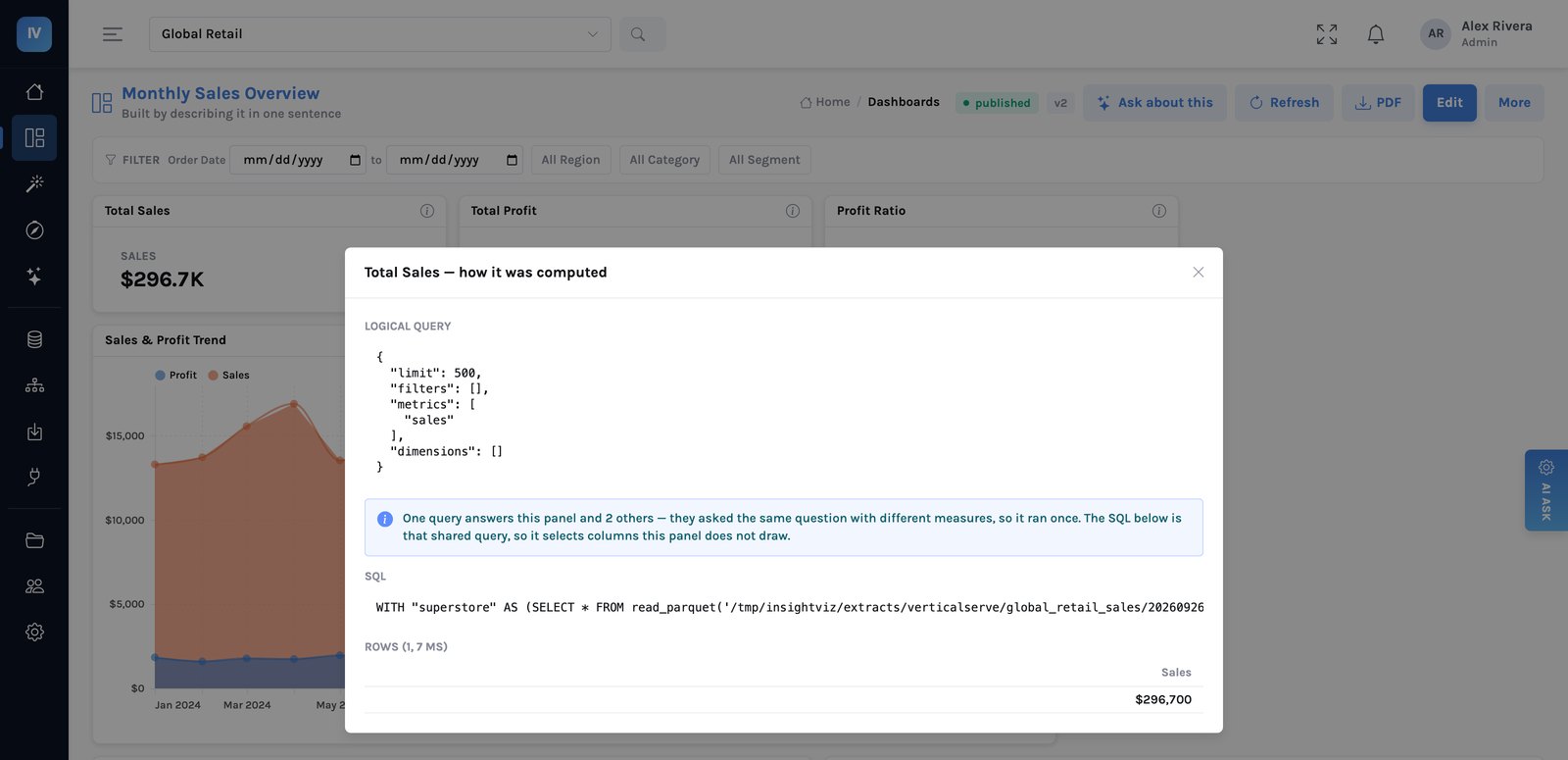
Not SQL. A logical query — a small structured object naming things from your model, with no notion of tables, joins or syntax.
| Key | What it holds | Example |
|---|---|---|
dimensions | What to group by, optionally with a time grain after a dot. | ["region", "order_date.month"] |
metrics | What to aggregate. Named, never expressed. | ["net_revenue", "orders"] |
filters | Field, operator, value. Values are always bound, never spliced into text. | {field, op, value} |
order_by / limit | Sort and cut. A limit is always applied, with a ceiling. | 500 |
table_calcs | Running totals, ranks, moving averages — declared, not written. | running_total |
Every name in that object is checked against the model's catalogue before anything runs. A name that is not there is refused and reported. That single check is what makes an invented field impossible rather than unlikely, whether the query came from a dashboard, from Explore, or from the assistant.
Four statements, one input shape, and every difference between them came from either the model or the person — never from something deciding in the moment.
What the compiler does with it
flowchart TD
    LQ["Logical query"] --> V["Resolve every name
against the catalogue"]
    V -->|"unknown name"| X["Refused and named"]
    V --> J["Pull in only the joins
the named fields need"]
    J --> P["Apply row policies → WHERE
column policies → removed"]
    P --> D["Derived fields: bins,
groups, sets, parameters"]
    D --> G["GROUP BY at the model's grain"]
    G --> W["Window pass for table calcs,
outside the grouping"]
    W --> S["SQL + bound parameters"]
    style P fill:#fff4e6,stroke:#f0cb9a
    style X fill:#fdecec,stroke:#eab6b6
    style S fill:#e6f7f2,stroke:#9fd8c9
Three of those steps are worth expanding, because they are where the interesting decisions are.
Joins are pulled in, never chosen
The model declares its relationships once, written by someone who knows the grain. The compiler includes a join only when a named field needs it — so a query touching one table produces a single-table statement, and a filter on a joined dimension pulls that join in by itself.
Nothing at query time decides which key to join on. That decision was made once, is reviewable, and cannot be got wrong differently on Tuesday.
Policies go in here, not afterwards
Run the query, then remove rows the person may not see. Totals are computed on everything and then presented to someone entitled to a subset — so the sum of the visible rows does not match the total on the card.
A row policy becomes a WHERE clause; a column policy removes the dimension from the catalogue before resolution. Totals are genuinely the person's own, and a hidden field cannot be named at all.
The property this buys you for free
Because the policy is inside the SQL, a cached result keyed on the SQL and its bound values is automatically keyed on the policy. Two people with different access compute different keys and can never be served each other’s numbers. We did not add a check for that — it falls out of doing the compilation in the right order, which is the best kind of security property.
Table calculations happen outside the grouping
A running total or a percent-of-total is not an aggregate; it is a window over the
aggregated rows. Getting this wrong — computing it inside the GROUP BY
— produces numbers that look plausible and are wrong.
So the compiler emits a second pass: aggregate first, then window over the result. Seven calculations are declarable, and they are declared by name rather than written:
| Declared as | What it emits |
|---|---|
running_total | A cumulative sum ordered by the query’s own ordering |
percent_of_total | The value over the window sum, at the partition you name |
rank / dense_rank | Ranking within the partition |
difference / percent_difference | Against the previous row |
moving_average | Over a window of rows you specify |
Values are bound, always
This is the unglamorous rule that matters most. Every value from a filter, a parameter, a group definition or a set becomes a bound parameter. None of it is formatted into the statement text.
A dashboard parameter is a one-row CTE cross-joined into the query rather than a string substitution — which is more work than interpolation and is the difference between a parameter control and an injection point.
Anything a person can type is a bound value. There is no path from a filter box to the text of a statement, and that is a structural property rather than an escaping function somebody has to remember to call.
Why this is where the AI safety actually is
The assistant produces a logical query and nothing else. It never holds a connection, never writes SQL, and cannot reach around the compiler because there is nowhere to reach.
That is why the answer to “what stops the AI doing something stupid?” is not a prompt. It is that the assistant's entire output surface is a small object whose every field is validated before anything executes. The full mechanism →
What it costs
A compiler is a constraint, and it is honest to name what the constraint excludes.
- You cannot write arbitrary SQL in a panel. Deliberate — an arbitrary statement cannot have policies compiled into it, so allowing one would put a hole in every property above. Arbitrary SQL belongs in the model, where it is reviewed once.
- Some things the model cannot express are genuinely not expressible. Correlated subqueries across grains, certain window-of-window constructions. These are real gaps and the honest answer is to model the thing you need rather than to escape the compiler.
- Adding a capability means adding it properly. Every new construct has to compose with policies, parameters, drill and caching. That makes the compiler the slowest-moving part of the product, which is correct and occasionally frustrating.
What to ask any vendor
- Where are row policies applied — in the query, or to the results? If the answer is the results, ask what the totals show.
- Is a cached panel keyed on the person’s access? If the key is the query alone, two people with different entitlements share a cache entry.
- Can a user or an AI supply raw SQL? If yes, ask how policies are enforced on it. There is usually no good answer.
- Show me the query behind this number. If the product cannot, nobody can audit it.
Why every panel shows its working → · How the policies are set →